
Two years ago, the All-Island Strategic Rail Review (AISRR), jointly commissioned by Ireland’s Department of Transport and Northern Ireland’s Department for Infrastructure, was published with the goal of delivering a pragmatic, long-term vision for an integrated rail network across the island. Included as part of their report were thirty-two recommendations for policymakers, ranging from increasing line speeds to at least 120 kilometres an hour to more localized initiatives, including reinstating the South Wexford Railway.
The review was blunt in its assessment of the current state of rail transport on the island; it cited the lowest level of electrified railway in the European Union, reduced speeds and frequencies, no rail links to any major Irish airport, and system-wide integration issues. Despite this, ridership numbers continue to rise, at least in Ireland, where Iarnród Éireann (Irish Rail) posted a record-breaking year in 2025, with 55 million passenger journeys. By contrast, passenger volume in Northern Ireland softened according to the most recent annual statistics, from 13.8 million to 13.3 million.
The review was equally incisive about the goals of a future, comprehensive all-island railway. This ambitious vision, shown below, ultimately relies on a significant increase in double-track railway, resolving critical connectivity gaps, and adding new stations (where necessary).
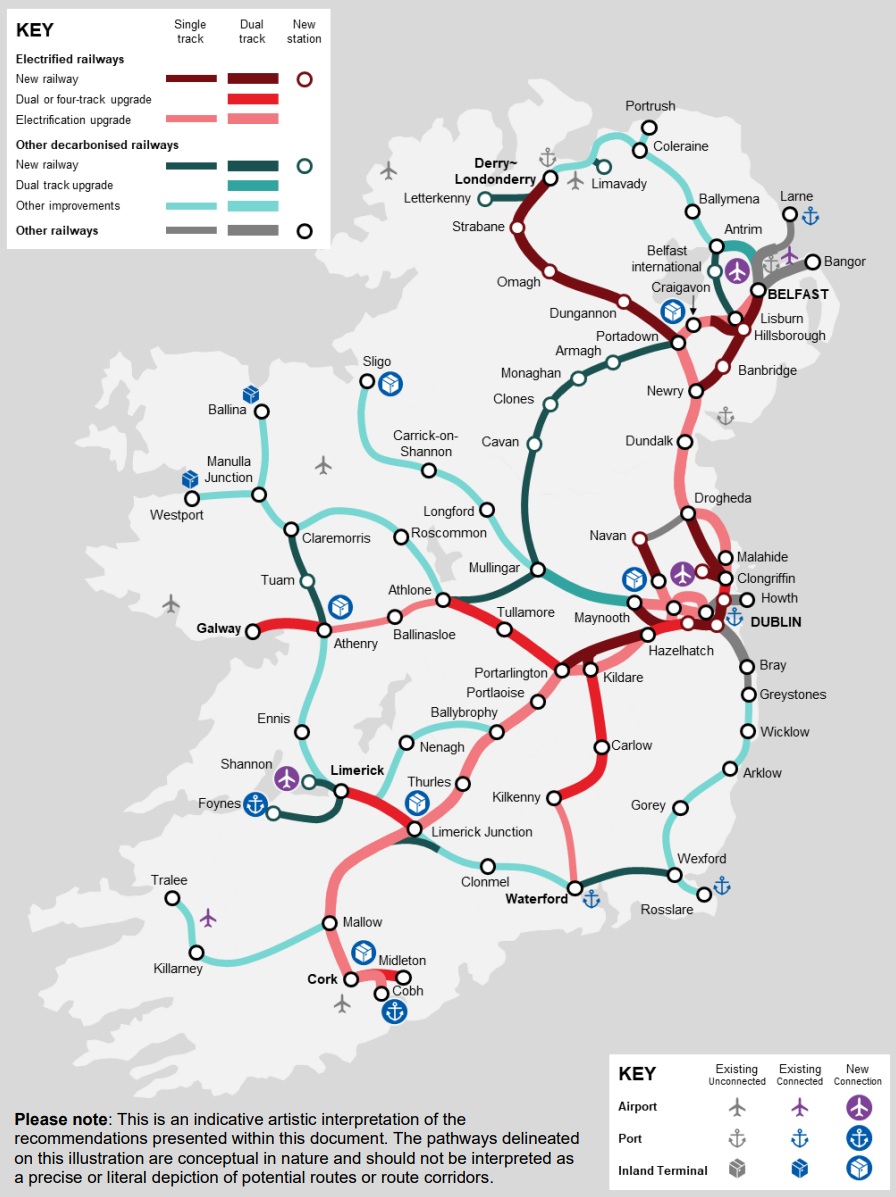
A future all-island railway (All-Island Strategic Rail Review, July 2024)
One route that is of particular importance in this multijurisdictional effort is the Belfast-Dublin corridor, which houses one third of the island's population and nearly 40% of its business base. The rapid growth and development in this particular stretch of land has progressed considerably since the 1920s, where the introduction of two separate jurisdictions impacted traditional patterns of trade and commerce. Today there is greater cooperation and a strong willingness to capitalize on the opportunities that line this region.
Movement between the island’s two largest cities received a much-needed injection of capital last month, with the announcement of a nearly €700 million investment by the Irish government’s Department of Transport and Northern Ireland’s Department for Infrastructure. The funding has been earmarked for a new Enterprise fleet of trains operating between Belfast and Dublin. It is also complemented by an additional €165 million managed by the Special European Union Programmes Body (SEUPB) as part of the PEACEPLUS program.
(The SEUPB was established after the Good Friday Agreement to manage funding allocated to the PEACE programs. These were designed to support stability and prosperity in the North through a variety of projects funded by the European Union, Government of Ireland, Government of the United Kingdom of Great Britain and Northern Ireland, and Northern Ireland Executive. PEACEPLUS, with a value of €1.14 billion, is the latest iteration of said program and is set to expire in 2027.)
This combined figure of over €850 million will allow for the procurement of eight purpose-built trains due for delivery in 2028. Designed by Swiss manufacturer Stadler, and based on their top-selling FLIRT platform, the trains will feature 400 seats and be among the most accessible intercity fleets in Europe, with step-free interiors and unaided boarding. They will also feature modern customer facilities, contemporary bar and dining areas, as well as a premium Enterprise Plus section.
Beyond the in-transit experience, this new fleet will allow for an expansion in services, with daily round trips rising to sixteen and a target express journey time of under two hours. The trains will also be “Ireland’s first tri-mode trains, capable of operating on electric, diesel, and battery power” according to a Translink spokesperson. Furthermore, the design of the power car “will allow for the future replacement of the diesel engines and fuel tank with pantographs and a transformer in the event of the Northern Irish network being electrified…"
First Minister of Northern Ireland Michelle O’Neill noted the immense benefits such a significant investment will have for the all-island economy, while Taoiseach Micheál Martin called it a “new chapter for cross-border rail connectivity on the island…”
As rail transportation becomes increasingly important in a world where sustainability has become ubiquitous in every policy decision—albeit the weight of such a consideration ebbs and flows with the government du jour—it is essential that it is built to maximize reach and economic impact. Funding for the Belfast-Dublin corridor will do exactly this, servicing the island’s most important region and positioning it for greater prosperity. While this announcement only scratches the surface of the recommendations outlined in the AISRR, it is a meaningful step in the right direction.